China Travel and Destination Guide  
   Last updated on
tibet travel and tibet tour nanjing travel and nanjing tour suzhou travel and suzhou tour hangzhou travel and hangzhou tour sichuan travel and sichuan tour zhaoxing travel and zhaoxing tour kaili travel and kaili tour longsheng travel and longsheng tour longji travel and longji tour sanjiang travel and sanjiang tour blog yunnan travel and yunnan tour shanxi tour and shanxi travel pingyao tour and pingyao travel datong tour and datong travel taiyuan tour and taiyuan travel guizhou travel and guizhou tour chengdu travel and chengdu tour xian travel and xian tour lhasa travel and lhasa tour guilin travel and guilin tour yangshuo travel and yangshuo tour kunming travel and kunming tour dali travel and dali tour lijiang travel and lijiang tour zhongdian travel and zhongdian tour beijing travel and beijing tour shanghai travel and shanghai tour china travel and china tour danba travel and danba tour daocheng travel and daocheng tour litang travel and litang tour yading travel and yading tour kangding travel and kangding tour dege travel and dege tourblog

China Tour Search
Departure City in China:
Destinations to include:
Beijing   Hong Kong
Lijiang     Lhasa
Pingyao  Kunming
Zhaoxing Shanghai
Xian        Guilin
Chengdu Suzhou
Quick Search :

Type attraction name, like    "Great Wall"
Destinations, type city    name, as "Zhongdian"
Try any words in your mind    of China
Trip Length:

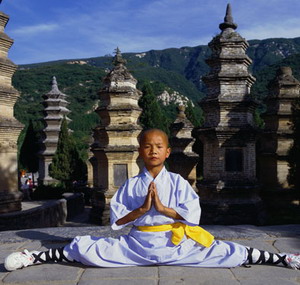
A visit to Shaolin Temple, China

There were 5 main temples at the height of the Shaolin order, though all 5 temples were rarely active at the same time.

Henan : This is "the" Shaolin temple seen in Chinese kung fu movies, and the one portrayed in the ABC-TV "Kung Fu" series of the 1970s. The physical premises, located in Loyang, a small mountain town southwest of Beijing, have been restored by the Chinese government in the mid 1970s (the temple was destroyed as a result of the Boxer Rebellion of 1901, but probably not until the late 1920s), and subsequently become a tourist/martial arts Mecca. Most of the resident "monks" seen today are actors, similar to the people you would meet in Colonial Williamsburg and other historical sites. During most of its history, Henan Temple was the seat of the most senior monks in the Shaolin Order.

Fukien : Probably built around the same time as Henan Temple, but originally a mainstream Buddhist temple until the early 1600s. This temple was integrated into the Shaolin order around 1650. Larger than the Henan Temple, Fukien served as the "headquarters" during times when Henan was either destroyed or under threat. The southern styles of praying mantis, snake, dragon, and Wing Chun were all developed in Fukien Temple, or by its masters. The temple was burned during the Boxer Rebellion, and its remains were rediscovered in the early 1980s.

Kwangtung : southern school, taught many great warriors, snake temple. Temple was built in late 1700's as a Shaolin temple, built in a mountain area overlooking the ocean near the city of Canton in Canton Province. This Cantonese temple was close to (ca. 150 miles southwest) Fukien, and was home to many southern styles, including Choy Li Fut and dragon (styles often originated in one location and were modified at others). Shelled during the civil warring following the Boxer Rebellion.

Wutang : Tiger temple. Located near the town of Wutang. Built in a politically unstable area (near Manchuria and the Korean peninsula). Probably the temple most involved with temporal concerns, and consequently often besieged by one army or another. Mercenary monks, including Bok Lei, Hung Si Kuan, and Bok Mei all came from Wutang, eventually moving to Henan (and thus involving Shaolin in its biggest political incursion). Very old temple, integrated into the Shaolin order around AD 800.

O Mei Shan : (literally, "Great White Mountain"), northern, library and medical temple. This temple was located in an inaccessible area of the Szechuan province and imported monks much like research institutions do today. The temple itself was very old, probably Taoist in origin. Integrated into Shaolin order around AD 1500. Was in close contact with Tibet. Crane temple. This was a major medical "school" for four centuries, the libraries filled with tomes from East and West. The buildings were used for artillery practice by the armies of both Shang Kai Shek and Mao Tze Tung, but restored in the early 1970s. Today, the "temple" serves as the conservation service headquarters for the bamboo forests of Szechuan and research center for the pandas.

History of Shaolin

The Shaolin order dates to about 540 A.D., when an Indian Buddhist priest named Bodhidharma (Tamo in Chinese), traveled to China to see the Emperor. At that time, the Emperor had started local Buddhist monks translating Buddhist texts from Sanskrit to Chinese. The intent was to allow the general populace the ability to practice this religion.

This was a noble project, but when the Emperor believed this to be his path to Nirvana, Tamo disagreed. Tamo's view on Buddhism was that you could not achieve your goal just through good actions performed by others in your name. At this point the Emperor and Tamo parted ways and Tamo traveled to the nearby Buddhist temple to meet with the monks who were translating these Buddhist texts.

The temple had been built years before in the remains of a forest that had been cleared or burned down. At the time of the building of the temple, the emperor's gardeners had also planted new trees. Thus the temple was named "young (or new) forest", (Shaolin in Mandarin, Sil Lum in Cantonese).

When Tamo arrived at the temple, he was refused admittance, probably being thought of as an upstart or foreign meddler by the head abbot (Fang Chang). Rejected by the monks, Tamo went to a nearby cave and meditated until the monks recognized his religious prowess and admitted him. Legend has it that he bored a hole through one side of the cave with his constant gaze; in fact, the accomplishment that earned his recognition is lost to history.

When Tamo joined the monks, he observed that they were not in good physical condition. Most of their routine paralleled that of the Irish monks of the Middle Ages, who spent hours each day hunched over tables where they transcribed handwritten texts. Consequently, the Shaolin monks lacked the physical and mental stamina needed to perform even the most basic of Buddhist meditation practices. Tamo countered this weakness by teaching them moving exercises, designed to both enhance chi flow and build strength. These sets, modified from Indian yogas (mainly hatha, and raja) were based on the movements of the 18 main animals in Indo-Chinese iconography (e.g., tiger, deer, leopard, cobra, snake, dragon, etc.), were the beginnings of Shaolin Kung Fu.

It is hard to say just when the exercises became "martial arts". The Shaolin temple was in a secluded area where bandits would have traveled and wild animals were an occasional problem, so the martial side of the temple probably started out to fulfill self-defense needs. After a while, these movements were codified into a system of self-defense.

As time went on, this Buddhist sect became more and more distinct because of the martial arts being studied. This is not to say that Tamo "invented" martial arts. Martial arts had existed in China for centuries. But within confines of the temple, it was possible to develop and codify these martial arts into the new and different styles that would become distinctly Shaolin. One of the problems faced by many western historians is the supposed contraindication of Buddhist principles of non-violence coupled with Shaolin's legendary martial skills. In fact, the Shaolin practitioner is never an attacker, nor does he or she dispatch the most devastating defenses in any situation. Rather, the study of kung fu leads to better understanding of violence, and consequently how to avoid conflict . Failing that, a Buddhist who refuses to accept an offering of violence (i.e., and attack) merely returns it to the sender. Initially, the kung fu expert may choose to parry an attack, but if an assailant is both skilled and determined to cause harm, a more definitive and concluding solution may be required, from a joint-lock hold to a knockout, to death. The more sophisticated and violent an assault, the more devastating the return of the attack to the attacker. Buddhists are not, therefore, hurting anyone; they merely refuse delivery of intended harm.

The Shaolin philosophy is one that started from Buddhism and later adopted many Taoist principles to become a new sect. Thus even though a temple may have been Taoist or Buddhist at first, once it became Shaolin, it was a member of a new order, an amalgamation of the prevailing Chinese philosophies of the time.

Other temples sprung from Henan. This happened because the original temple would suffer repeated attacks and periods of inactivity as the reigning Imperial and regional leaders feared the martial powers of the not-always unaligned monks. Refugee Shaolin practitioners would leave the temple to teach privately (in Pai) or at other Buddhist or Taoist temples. In rare cases, a new Shaolin Temple would be erected (Fukien, Kwangtung) or converted from a pre-existing temple (Wu-Tang, O Mei Shan). Politically and militarily involved monks (such as the legendary White Eyebrow and Hung Tze Kwan) would be perpetual sources of trouble for the generally temporally aloof monks.

Life in the temples                Introduction of Shaolin

Information offered by www.shaolin.com


Personal Expert in China travel & China tour... china tour and china travel .Shrouded in mystery and isolated from the outside world for many, many years, China tour has opened its borders and its heart to welcome travelers into this most fascinating country. If you travel nowhere else, China travel! A morning visit to the Forbidden City has been arranged to catch the morning rays of sunlight as they cascade across the golden rooftops of the palace temples and halls. Adequate time has been set aside for photography and exploring the most popular areas of the complex. Your visit will then continue on to 100-acre Tiananmen Square, the world's largest open square. Photographic opportunities include famous Tiananmen Gate, Mao's Mausoleum, the monument to the people's heroes, and the Great Hall of the People In these tiny villages, nestled beneath Dupang Mountain in southwestern China tour, centuries-old traditions prevail. Water buffaloes pull plows through fields as villagers harvest by hand. Few of the sun-dried brick homes have plumbing. And religious prohibitions on activities like washing or cutting trees by a spring hold sway.. .In China tour, tool of conservation is a camera, there are 54 nations living in this country, and hundreds of dialets, sometimes even your local tour guide has no idea to communicate with local villages... Longsheng is famous for the Dragon's Backbone Rice Terraces: 60square kilometers of terraced rice fields southeast of Longsheng. They were first built in the Yuan dynasty and completed in the Qing dynasty by Zhuang people. The terraced fields are built along the slope winding from the riverside up to the mountaintop, with the highest place of an elevation of 885m and the lowest 380m. The coiling line spirals up from the mountain foot to the top, making the mountain looks like huge snail seen from afar. Incredible trips to 5 historical cities which can be dated back to more than 2000 years ago. Take train, bus, cruise to ancient China tour which can only be found in your dreams. Limited special package only avaible once in a month. China travel is much more than the Great Wall, the terra-cotta warriors of Xian, Beijing or panda bears. China travel is people…accomplished, creative, vibrant people like the Han, Naxi, the H'mong, the Bai, and the Tibetans – people who built elaborate monasteries, temples and pagodas, people who established great, progressive cities and kingdoms, and people who still live in ancient and remote villages. You will get to meet all these people and celebrate with them, sing and dance, hear their stories, dine at their tables and become part of their thriving culture. Circumambulate Kawakarpo, the second holiest mountain to all the Tibetans, with the pilgrims during the very special Year of the Sheep. Leave your problems behind at Ringha Temple, see the markers along the trail of Mao's Long March, investigate the Bardo Caves, where pilgrims meditate on the transition between this life and the next. Stop at nunneries, sleep in village guest houses, and walk flowering yak meadows.... Our knowledgable English speaking tour leader escort your trip. They know where to target. A seminar will be hosted by professional artist in photograph for each our photo tour program. Interested in Taking photos in China travel? Please contact Mr. Stewart Shen , our tour co-ordinator for Photograph Tour for more details.    blog

Sinoway Travel is the expert in China travel services, China tours, China bike tours, Yangtze River cruise, China festivals, China trekking tour, China Minority Ethnic Culture tours. Copyright © 2004 Sinowaytravel.com™ All rights reserved,

More questions, tell me by email