
 About Beijing

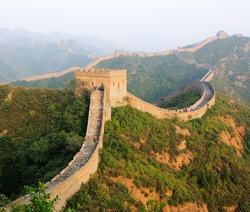 Built on the Great and lesser Gold mountains (Jinshan), this section is called the Gold Mountain (Jinshanling) Great Wall. According to historical records, the construction of this part of the wall was begun in 1571, and is part of the 1,000-kilometer-long section of the wall between the Shanhai Pass in the east and Changping County in the west, which was the result of cooperation between two famous Ming generals, Qi Jiguang and Tan Lun. In terms of construction it is in no way inferior to the wall at Badaling.
The Great Wall at the Gold Mountain (Jinshanling) is seven meters high, six meters wide, and built of rectangular slabs of stone. The brick-paved walkway along the top of the wall is four meters wide and the crenellated openings two meters wide. In the merlons (the solid intervals between the crenels) there are small holes for observation and shooting arrows. There are also special openings between the crenels to insert flags for display or signal transmission.
The 158 battle platforms in the Gold Mountain section of the Great Wall were designed in a great variety of shapes-square, circular, oval and multi-cornered. Their interiors are constructed of wood or brick and their roofs are flat, domed or barrel-vaulted. There are also variations in the shape of the archways, which give access to the battle platforms.
Photographers know that the best place to take pictures of the Great Wall is not Badaling or Shanghaiguan, but Jinshanling. The Great Wall from Simatai in Beijing to Jinshanling in Hebei is the best preserved stretch, so many overseas visitors choose it. It is said that there are more overseas Great Wall climbers in Jinshanling than Chinese. People also say that anyone who has climbed Jinshanling is not interested in seeing any other part of the Great Wall, as it retains its original Ming Dynasty outlook, and so vividly reflects the full ethos of that epoch.
Members of the Great Wall Green Project Investigation Group have walked the entire length of the Great Wall, and many of them believe Jinshanling to be its most beautiful section. Not having been fully renovated, parts of it are in ruins, so it has a more natural ambience than other stretches of the wall that have been completely rebuilt. Jinshanling is far less crowded than Badaling or the Shanhaiguan Great Wall, thus giving today's climbers a hint of the isolation that must have been felt by its ancient defenders.
Zhou Wanping is a photographer who lives at the foot of the Jinshanling Great Wall. In the preface to his published photograph album, My Home Town, he says: "At the time I graduated from high school and went home, the Jinshanling Great Wall was being repaired. Although sick, I participated in the renovation process along with other villagers. This experience fully brought home to me the hardship involved in the original construction of the Great Wall. All the bricks, lime and water needed for construction had to be carried to the site on the backs of laborers".
Chinese imperial dynasties appeared, prospered and died out through history. The Great Wall bears witness to their vicissitudes, and demonstrates the Chinese people's hard working spirit, and the splendid culture and history of the Chinese civilization.